
Tree-climbing lions, flamingo-fringed alkaline shores, dense groundwater forest, and wildlife that rewards the attentive traveler — Lake Manyara is Tanzania’s most compact and most unexpectedly rich safari destination.
Introduction
Tanzania’s northern safari circuit is renowned for superlatives. The Serengeti is the world’s greatest wildlife ecosystem. The Ngorongoro Crater is the finest concentrated Big Five destination on the planet. Tarangire holds Africa’s most spectacular dry-season elephant concentrations within a landscape of thousand-year-old baobab trees. Against these headline destinations, Lake Manyara National Park might appear — at first glance, on paper — to be the supporting cast. Compact at 330 square kilometers, frequently allocated a half-day or single night in standard northern circuit itineraries, and rarely the primary motivation for a Tanzania safari journey, it risks being treated as an obligatory check on a wildlife checklist rather than a destination warranting genuine attention.
That would be a significant mistake.
Lake Manyara safari tour one of East Africa’s most surprising and most rewarding wildlife destinations — a park whose compact geography belies an extraordinary concentration of habitat diversity, wildlife species, and specific encounter quality that travellers who give it focused attention consistently describe as one of the highlights of their entire Tanzania journey. The legendary tree-climbing lions that drape themselves in the branches of fig and mahogany trees above the park road. The alkaline lake margins where thousands of flamingos gather in vivid pink congregations visible from kilometers away. The dense groundwater forest that receives visitors with a cathedral-like darkness punctuated by shafts of filtered equatorial light and the calls of troops of olive baboons and blue monkeys moving through the canopy. The enormous hippo pools of the southern wetlands, visited by buffalo herds and elephant families that cross the wallowing pools with the unhurried confidence of permanent residents.
This article is your definitive guide to the Lake Manyara safari tour — covering the park’s ecology and habitats, its defining wildlife encounters, the famous tree-climbing lions in detail, the best time to visit, where to stay, how to structure a Lake Manyara visit within a broader northern circuit itinerary, and everything that ensures this compact, underestimated park is experienced with the attention and depth it deserves.
Lake Manyara: Geography, Geology, and Ecology
A Park of Extraordinary Habitat Compression
Lake Manyara National Park occupies a narrow strip of land between the base of the western wall of the Great Rift Valley — the geological fault that runs the full length of East Africa from the Afar Depression in Ethiopia to Mozambique — and the western shore of Lake Manyara itself. This compressed geography creates a park of remarkable ecological diversity within a small area: the park is approximately 50 kilometers long from north to south but rarely more than 15 kilometers wide, with the Rift Valley’s escarpment rising dramatically to the west and the alkaline lake dominating the eastern boundary.
Within this narrow strip, five distinct habitat zones are compressed into a succession that travellers experience in rapid sequence during a game drive that moves from the forest-covered escarpment base southward along the lake shore and into the open floodplains and wetlands of the park’s southern reaches. No other northern Tanzania park delivers equivalent habitat variety within such a compact driving distance — a quality that makes Manyara exceptionally time-efficient for safari travelers and exceptionally productive for naturalists seeking species diversity within limited time.
The Great Rift Valley Setting
The Rift Valley escarpment wall that forms Lake Manyara’s western boundary is not merely a geographic feature but a visual backdrop of extraordinary drama — a wall of rock and forest rising 600 meters above the park floor, streaked with waterfalls during the wet season and draped in the dense groundwater forest that receives rainfall channelled from the escarpment’s highland catchments. The visual relationship between the escarpment wall, the forested park floor, and the gleaming alkaline lake creates a scenic context for the Lake Manyara safari tour that is unique within the northern Tanzania circuit.
The Manyara area was recognized for its exceptional wildlife and scenic value by Ernest Hemingway, who visited in the 1930s and described it as “the most beautiful lake in Africa” — a description that the contemporary visitor, arriving at the escarpment viewpoint overlooking the park before descent, will find entirely comprehensible.
Wildlife: Lake Manyara’s Defining Encounters
The Tree-Climbing Lions: Manyara’s Most Famous Residents
No wildlife phenomenon in Lake Manyara captures the imagination of safari travelers more completely than the park’s famous tree-climbing lions. While lion tree-climbing behavior has been documented in a small number of African locations — notably Uganda’s Queen Elizabeth National Park and to a lesser extent the Serengeti’s Ndutu area — Lake Manyara is the destination most consistently associated with this behavioral curiosity, and the one where it is most reliably observed.
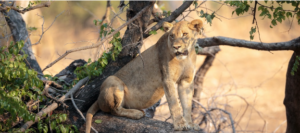
The behavior involves lion prides ascending into the branches of large fig, mahogany, and acacia trees during the heat of the day — resting in elevated positions that provide cooling breezes, relief from ground-level insects and tsetse flies, and elevated vantage points over the surrounding park floor. Individual lions and entire pride sections are regularly found draped in the branches of large fig trees along the park road, sometimes at heights of four to six meters, with their legs hanging on either side of major branches in attitudes of such complete relaxation that they appear genuinely, comfortably at home in their arboreal perches.
The precise ecological explanation for this behavior — whether it developed as a learned response to the Manyara ecosystem’s specific conditions, or represents a cultural tradition transmitted through social learning within specific pride lineages — has been debated by wildlife biologists for decades without definitive resolution. The uncertainty only adds to the fascination of the encounter for travelers who observe a lion in a tree and realize, in the same moment, that this large predator is doing something that its design does not appear to have anticipated.
For wildlife photographers, a tree-climbing lion encounter offers a compositional opportunity unavailable anywhere else in Tanzania — the animal positioned at eye level or above, framed by the natural architecture of large branches, with the dappled green light of the forest canopy creating a quality of portrait illumination that open savannah encounters cannot provide.
Elephants: The Forest and Floodplain Population
Manyara’s elephant population numbers approximately 400 to 500 individuals — a relatively compact but well-studied group that has been the subject of significant elephant behavioral research, most notably through the work of Dr. Iain Douglas-Hamilton, who conducted his pioneering elephant social structure research in Manyara in the 1960s and whose findings established the foundational understanding of elephant family dynamics that has shaped elephant conservation science ever since.
Manyara’s elephants are notable for their frequent use of both the park’s dense groundwater forest and the open floodplains adjacent to the lake shore — creating encounters of a quite different character depending on where in the park they are located at time of observation. An elephant family group moving through the groundwater forest, the large trees framing the animals and reducing the background to a green wall of vegetation, creates photographic compositions of exceptional intimacy. The same family group feeding on the open floodplain against the backdrop of the alkaline lake and the flamingo-fringed shore provides the visual scale and context that open habitat encounters deliver.
Flamingos and Waterbirds: The Alkaline Lake Spectacle
Lake Manyara is a soda lake — alkaline, mineral-rich, and shallow — of a type found across the East African Rift Valley. The lake’s chemistry creates conditions that support massive blooms of the cyanobacteria Arthrospira that constitutes the primary food source of lesser flamingos — and when these conditions are optimal, lesser flamingos gather on Lake Manyara’s shores in their hundreds of thousands, their combined plumage transforming the lake’s edge into a vivid, shimmering band of deep rose pink visible from the Rift Valley escarpment above.
The flamingo concentrations are seasonal and variable — dependent on the lake’s water level and chemical conditions, which shift with rainfall patterns — but at their peak represent one of East Africa’s most dramatically beautiful wildlife spectacles. Greater flamingo, pelican, yellow-billed stork, African spoonbill, various heron and egret species, and an extraordinary diversity of wader species accompany the flamingo flocks on the lake margin, making the shoreline game drive one of Tanzania’s finest birding experiences even during periods when flamingo numbers are modest.
Hippos, Buffaloes, and the Southern Wetlands
The park’s southern wetlands — fed by springs and seasonal rivers flowing from the Rift Valley escarpment — maintain permanent water through the dry months and support significant hippo populations whose wallowing pools become focal points for broad wildlife aggregations. Buffalo herds of several hundred animals are regularly encountered in the southern zones, along with zebra, wildebeest, impala, waterbuck, and the smaller antelope species — Kirk’s dik-dik, bushbuck, and reedbuck — that inhabit the denser vegetation of the park’s wetter areas.
The southern hippo pools provide one of Tanzania’s most accessible and most entertaining hippo viewing environments — close-range observation of hippo social dynamics, including the territorial confrontations between large bulls that produce extraordinary vocalizations and dramatic physical displays, is possible from the park road at several pool locations without any extended vehicle positioning.
Primates: Baboons and Blue Monkeys in the Forest
Manyara’s groundwater forest supports large troops of olive baboons and blue monkeys — two primate species whose social complexity and behavioral range provide wildlife encounter material of genuine richness for travellers who take the time to observe them attentively.
Olive baboon troops of fifty to one hundred individuals are regularly encountered crossing the park road or foraging in the forest margins. The troops’ social dynamics — the hierarchical interactions between adult males, the maternal behavior of females with infants clinging to their backs, the play behavior of juveniles — provide hours of behavioral observation for patient observers. Blue monkeys — quieter, more arboreal, and more elegant than the robust baboon — are typically found in the mid-canopy of the groundwater forest, their blue-grey coats and distinctive white throat patches visible as they move through the branches above the road.
Birding at Lake Manyara: Over 400 Species in One Small Park
Lake Manyara National Park’s 400-plus confirmed bird species represent one of the highest per-area bird diversities in Tanzania — a reflection of the park’s habitat diversity and the different avian communities each zone supports. The groundwater forest holds a distinct forest bird community including the bar-tailed trogon, brown-headed apalis, and various forest warblers and sunbirds. The open floodplains support grassland and savannah species including kori bustard, secretary bird, and crowned crane. The lake margin adds waterbird diversity of extraordinary scope — storks, herons, egrets, spoonbills, pelicans, ibis, plovers, and sandpipers alongside the flamingo flocks. The forest-savannah interface adds spectacular species including the silvery-cheeked hornbill, African paradise flycatcher, and lilac-breasted roller.
For dedicated birdwatchers, Lake Manyara warrants a full day of focused observation — the habitat transitions encountered within a single north-south park drive produce species list additions with a frequency that few Tanzania destinations match per kilometer covered.
Best Time to Visit Lake Manyara
Dry Season (June through October)
The dry season provides the most reliable and most varied wildlife viewing at Lake Manyara. Vegetation is sparse enough to facilitate wildlife spotting, predators are concentrated near permanent water sources, and the elephant herds that retreat to the park during the dry months produce consistently excellent viewing conditions. The tree-climbing lions are observed year-round but are most frequently encountered during dry-season midday heat.
Green Season (November through May)
The green season transforms Manyara into a landscape of vivid, lush beauty — the escarpment forests deep green, the floodplains carpeted with fresh grass, and the lake often at higher water levels that modify both flamingo distribution and shore access. Migratory waterbirds dramatically expand the bird list from November onward, making this the peak period for dedicated birdwatching. Accommodation rates drop and visitor numbers are at annual lows during the long rains of March through May.
Where to Stay: Lake Manyara Accommodation
Lake Manyara Tree Lodge (&Beyond) sits within the park boundary — the only accommodation inside the park — in an extraordinary setting among mahogany trees above the forest floor. This ten-suite property provides the rarest Lake Manyara experience: night game drives within the park itself, available exclusively to Tree Lodge guests, that reveal a nocturnal world invisible to day visitors.
Kirurumu Manyara Lodge on the escarpment rim above the park offers panoramic views over the lake and park floor from a tented camp of considerable charm and strong guiding quality — the escarpment position provides morning and evening views of the Rift Valley that are among northern Tanzania’s most dramatic.
Escarpment Luxury Lodge provides high-standard accommodation on the escarpment above Mto wa Mbu town with lake views and good access to both Lake Manyara and nearby Tarangire.
Several mid-range camps around the town of Mto wa Mbu at the park gate provide comfortable options for budget-conscious travelers incorporating Manyara as part of a broader northern circuit itinerary.
Structuring a Lake Manyara Visit
As Part of the Northern Circuit
The overwhelming majority of Lake Manyara visitors experience the park as part of a multi-park northern circuit itinerary — typically as a half-day or full-day addition en route between Arusha and the deeper circuit parks. This is the most common and most time-efficient approach: the two-hour drive from Arusha arrives at the park gate in time for a morning game drive, allowing travellers to see the groundwater forest, tree-climbing lions (if present), lake shore flamingos, and southern hippo pools before departing for Ngorongoro or Tarangire in the afternoon.
One night at a Lake Manyara property upgrades the experience significantly — the addition of a night game drive within the park (for Tree Lodge guests) or an early morning drive before the day-visitor vehicles arrive creates a quality of exclusivity and wildlife access unavailable in a single-drive visit.
Key Takeaways
- Lake Manyara National Park is Tanzania’s most compact and most habitat-diverse northern circuit destination — five distinct ecological zones compressed into a 330-square-kilometer park that delivers extraordinary wildlife variety per kilometer of game drive.
- The park’s tree-climbing lions are one of Africa’s most distinctive and most photographically extraordinary behavioral wildlife phenomena — a behavioral curiosity documented in very few African locations, observed most reliably at Lake Manyara.
- Flamingo concentrations on the alkaline lake shore are among East Africa’s most visually spectacular wildlife displays when lake water conditions are optimal — lesser flamingos gathering in their hundreds of thousands to create a vivid rose-pink band visible from the Rift Valley escarpment above.
- Manyara’s 400-plus bird species represent one of Tanzania’s highest per-area bird diversities — the groundwater forest, open floodplain, and lake shore, each supporting distinct avian communities of exceptional richness.
- The park’s elephant population was the subject of Dr. Iain Douglas-Hamilton’s foundational elephant behavioral research — one of the most scientifically significant wildlife populations in East Africa’s conservation history.
- Lake Manyara Tree Lodge by &Beyond is the park’s only internal accommodation and the only property offering night game drives within the park boundary — an experience that reveals a nocturnal wildlife world invisible to day visitors.
- The Rift Valley escarpment forms Manyara’s western boundary, providing a visual backdrop of geological drama and a wildlife context of ecological richness that makes the park setting unique within the northern Tanzania circuit.
- Dry season (June through October) provides the most reliable predator viewing and tree-climbing lion encounters; the green season (November through May) offers spectacular birding as migratory species arrive and flamingo numbers peak.
- Lake Manyara is most commonly and most efficiently incorporated as a half-day to one-night addition to the northern circuit between Arusha and the deeper parks — even a single morning game drive delivers distinctive wildlife encounters unavailable elsewhere.
- The park is particularly compelling for birdwatchers, photographers, and primate enthusiasts alongside the standard Big Five-focused safari traveler — its species and habitat diversity rewards every specialist interest within the general safari framework.
Questions & Answers
Q: Are the tree-climbing lions always present and how can I maximize my chances of seeing them? The tree-climbing behavior is observed year-round but is neither guaranteed on every visit nor limited to a specific season. The lions climb trees most frequently during the midday heat — typically from mid-morning through early afternoon — when elevated positions provide cooling breezes and relief from ground-level insects. Guides with radio networks who are in constant communication with other vehicles throughout the park significantly improve sighting probability by tracking reported lion positions in real time. Extended time in the park — a full day rather than a half-day visit — dramatically increases the probability of an encounter, as does staying in-park at Lake Manyara Tree Lodge, where guides have the longest daily exposure to the park’s resident prides. It is worth noting that even on visits when the tree-climbing lions are not observed in trees, Lion sightings at ground level are reliable — the behavioral curiosity of the trees is the exceptional encounter, but Manyara’s lions are present and visible in conventional safari fashion on most park visits.
Q: How long should I allocate to Lake Manyara in a northern circuit itinerary? The minimum meaningful Lake Manyara experience is a half-day game drive — approximately three to four hours covering the full north-south extent of the park from the groundwater forest through the floodplain and hippo pools to the lake shore. This is sufficient to encounter the groundwater forest, attempt a tree-climbing lion sighting, observe flamingos on the lake margin, and visit the hippo pools — a range of genuinely distinctive encounters that justifies the stop even within a tight itinerary. One full day — two game drives, morning and afternoon — adds significantly to depth: the early morning drive catches predator activity and the spectacular quality of dawn light in the forest; the late afternoon drive catches the golden hour on the floodplain and lake shore in conditions of exceptional photographic beauty. One overnight stay is the minimum required to access night game drives at Tree Lodge and to experience the park at the full range of its daily behavioral cycle.
Q: What makes Lake Manyara different from other northern Tanzania safari destinations? Lake Manyara’s most distinctive quality is its habitat compression — the rapid transition between the dense groundwater forest, the open floodplain, the alkaline lake shore, and the southern wetlands within a single linear game drive creates a wildlife variety experience that the more homogeneous landscapes of the Serengeti and Ngorongoro Crater cannot replicate in the same distance. The park is also distinguished by the specific behavioral phenomena unique to it: tree-climbing lions, the flamingo spectacle, and the forest primate encounter all offer wildlife experiences unavailable in the headline parks. The Rift Valley escarpment setting provides a scenic context of geological drama that gives the park a visual distinctiveness among Tanzania’s northern circuit destinations. And the park’s relative compactness — the fact that a single game drive can traverse its full length — means that wildlife diversity is encountered efficiently in ways that more expansive parks cannot guarantee within equivalent time.
Q: Is Lake Manyara suitable as a standalone safari destination or only as part of a broader northern circuit? Lake Manyara functions most powerfully as part of a broader northern circuit itinerary — its compact size means that extended stays begin to exhaust the park’s game drive routes after two to three days, and the depth of wildlife variety in the broader circuit is necessary context for the Manyara experience’s distinctive qualities to be fully appreciated. However, for travelers with specific interests — dedicated birdwatching, primate behavioral observation, or photography focused on the park’s distinctive aesthetic environments — Lake Manyara can serve as a satisfying standalone two to three-day destination. The &Beyond Tree Lodge’s night game drive program, the full bird list, and the tree-climbing lion encounter provide sufficient specific interest for a focused short-stay visit. The park also pairs excellently with the adjacent Ngorongoro Conservation Area and Tarangire for travelers seeking a compact central Tanzania wildlife experience without the longer northern circuit extension.
Q: How does the flamingo population at Lake Manyara compare to Kenya’s Lake Nakuru? Both Lake Manyara and Kenya’s Lake Nakuru are alkaline Rift Valley soda lakes that host lesser flamingo populations, and both are subject to significant population fluctuations driven by the cyanobacteria blooms that constitute the flamingos’ primary food source. At their respective peaks, Lake Nakuru has historically hosted slightly larger flamingo concentrations — in optimal conditions, an estimated one to two million birds — but the flamingo population at Nakuru has been significantly disrupted by rising lake water levels in recent years, driven by changing regional hydrology, that have diluted the lake’s chemistry and reduced the cyanobacteria bloom that sustains the flamingos. Lake Manyara’s flamingo concentrations have been relatively more stable, and the park’s additional wildlife diversity — the tree-climbing lions, the groundwater forest, the elephant population — means that a Lake Manyara visit delivers outstanding value even on days when flamingo numbers are at the lower end of their seasonal range. The two lakes are not in direct competition; travelers completing both an East Africa northern circuit and a Kenya safari will find them rewarding in different ways and at different times.
Q: What is the Mto wa Mbu cultural experience and how does it complement a Lake Manyara safari tour? Mto wa Mbu — the market town at Lake Manyara’s northern park gate — is one of Tanzania’s most culturally diverse small towns, a place where representatives of over 120 different tribal groups live and trade alongside each other in a linguistic and cultural multiplicity that makes it unique in the region. The town’s name translates literally as “Mosquito Creek” — a reference to the river that flows through it — and its markets, banana plantations, and craft shops provide a genuinely engaging cultural experience that many operators incorporate as a half-day village walk component of the Lake Manyara itinerary. Culturally managed walking tours through the town and surrounding farming community provide context for the agricultural and social landscape of the Manyara area that the park game drive alone cannot deliver, and the town’s craft market offers one of the northern circuit’s finest opportunities for purchasing high-quality traditional artisan work directly from its makers at fair-trade prices.
Conclusion
Lake Manyara safari tour National Park occupies a particular and precious place in the northern Tanzania safari landscape — not as a headline destination that demands the longest stays and the most extravagant expectations, but as a destination of surprising, compact richness that rewards any traveler willing to look beyond its modest footprint and its supporting-cast reputation to what it actually contains.
The tree-climbing lion discovered in the branches of a great fig tree, its legs hanging on either side of a major branch with the casual indifference of a creature entirely at home in a position that its body was never designed for, creates a moment of delighted disbelief that very few other wildlife encounters in Tanzania can produce. The flamingo-fringed lake shore, the vivid pink visible from the escarpment viewpoint above before the descent even begins, creates an anticipation that the park fulfills with the particular satisfaction of arriving somewhere that is exactly as beautiful as its advance reputation suggested. The groundwater forest receiving visitors with cathedral-filtered light and the calls of blue monkeys in the canopy above creates an atmosphere of tropical enclosure entirely unlike any other habitat in the northern circuit — a passage from open savannah to deep, living forest and back that compresses a day’s habitat variety into a single continuous experience.
These are not consolation prizes for travelers who could not get to the Serengeti. They are specific, distinct, and irreplaceable wildlife and landscape encounters that exist only at Lake Manyara and nowhere else in Tanzania’s extraordinary northern circuit. Give it the time it deserves — a full day at minimum, a night if the itinerary permits — and Lake Manyara will deliver exactly what every great safari destination delivers to the traveler who arrives with open eyes and genuine curiosity: more than was expected, and more than will ever be fully described.

